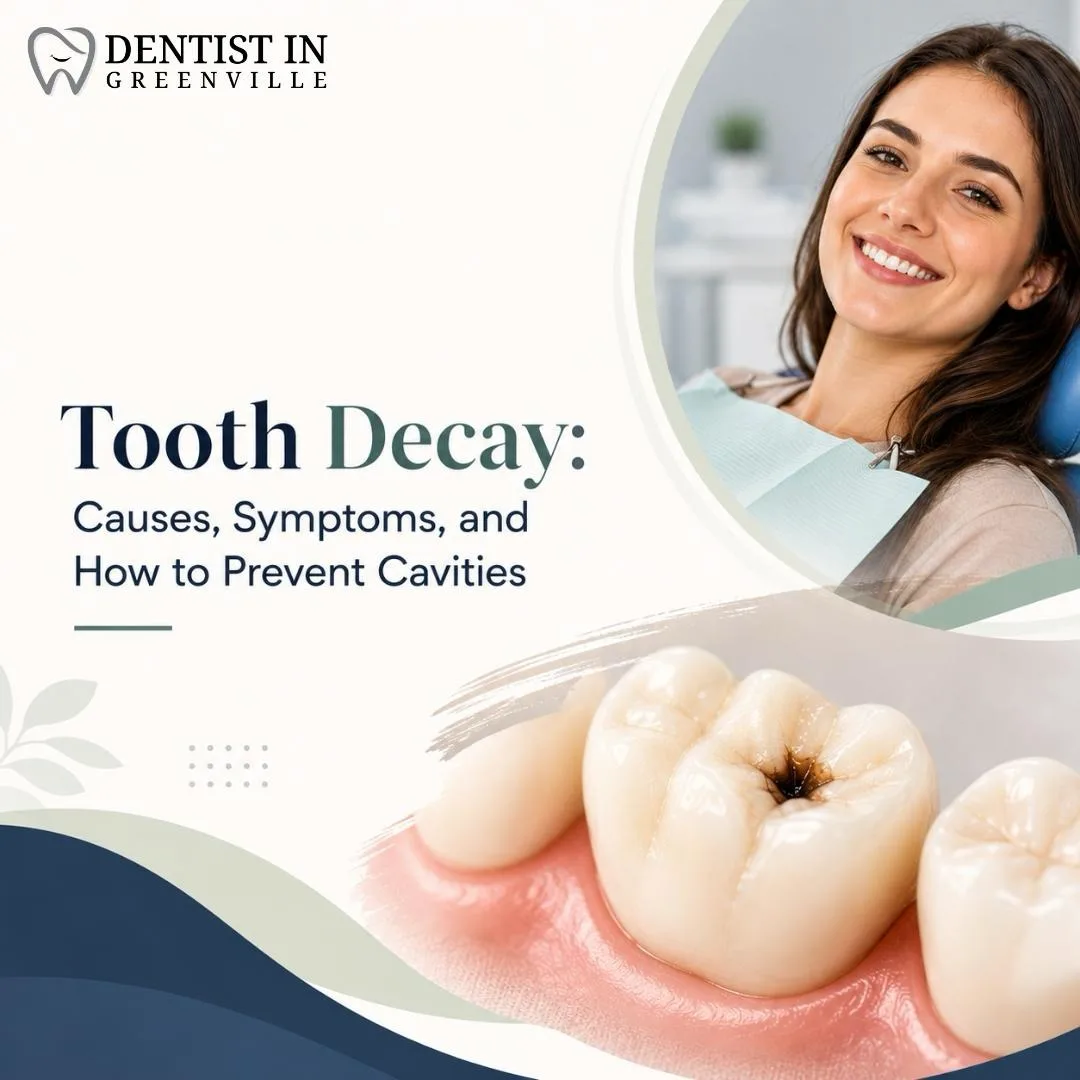
Many people feel a sharp toothache or notice a dark spot on a tooth and worry about cavities. Tooth decay starts quietly, as bacteria and plaque build up on tooth enamel after sugary snacks and sips. There are rarely any warning signs at the beginning — which is exactly why it spreads.
One fact drives everything below: bacteria make acids that wear away enamel, and enamel does not grow back. Once it is gone, a dentist has to replace it. Here you'll find the main causes, the common symptoms, and the steps that actually prevent cavities — brushing with fluoride toothpaste, daily flossing, cutting back on sugary drinks, and keeping regular dental exams and cleanings.
Already seeing a dark spot or feeling pain when you eat? Our tooth decay treatment in Greenville, SC catches it before it reaches the nerve. Call (864) 284-0066 to get in.
Tooth decay comes from a chain of everyday events, not one bad habit. Bacteria in the mouth form plaque, a sticky film that clings to teeth. Those bacteria live on sugars from food and drink — particularly sugary snacks and beverages. As they feed, they produce acids that attack the tooth's surface, and that acid weakens the enamel layer until a cavity forms.
What speeds the process up:
Once tooth enamel wears away, it does not regenerate naturally. Early softening can be remineralized with fluoride treatments, but an actual hole needs a restoration. Regular professional cleanings remove the hardened plaque a toothbrush leaves behind.
Cavities announce themselves gradually. A toothache is often the first sign people notice, and it can feel sharp or persistent. Sensitivity to hot, cold, or sweet foods is another common early complaint. As decay advances, visible holes or dark spots appear on the tooth surface where enamel has eroded.
Watch for any of the following:
Decay moves through stages: enamel demineralization, then a cavity through the enamel, then decay into the softer dentin beneath, and finally into the pulp where the nerve lives. Catching it in the first two stages usually means a small filling. Reaching the pulp usually means root canal treatment — and a tooth infection if it is left alone longer.
Pain that wakes you at night, facial swelling, or a fever means the decay has already reached the nerve. That is emergency dental care, not a wait-and-see situation.
Prevention is mostly boring and mostly effective. Brushing twice a day with fluoride toothpaste removes plaque and strengthens enamel against acid. Flossing daily clears the spaces between teeth where most adult cavities start — a brush simply cannot reach there. Rinsing after meals helps when brushing isn't an option.
When decay has already started, treatment is straightforward. Small cavities are restored with dental fillings — usually tooth-colored composite fillings in a single visit. Larger damage may need a crown, and decay that reaches the nerve needs a root canal. Treating it early is always the smaller, cheaper appointment.
Dentist in Greenville in Greenville, SC sees decay at every stage, from a first dark spot to a tooth that has been hurting for months. Call (864) 284-0066 or visit us at 4 Market Point Dr Suite E, Greenville, SC 29607 to book an appointment.
Bacteria in the mouth feed on sugars from food and drink. They form plaque that sticks to tooth enamel and produce acids that wear it away. Over time this leads to dental caries and enamel erosion. Sugary snacks and poor oral hygiene raise the risk.
You may feel a toothache or a sharp pain when you eat, or sensitivity to hot, cold, and sweet foods. You may see dark spots or small holes on a tooth. Bad breath and food packing into one spot are also common signs.
Brush twice a day with fluoride toothpaste and floss daily. Cut back on sugary snacks and drinks, and keep sweets to mealtimes. See a dentist every six months for a cleaning and exam. Good nutrition and steady hygiene do most of the work of cavity prevention.
A dentist places a filling for a small cavity that has not reached the nerve. If decay reaches the inner pulp of the tooth, you will need a root canal to save it. Treating decay early keeps you in the filling category instead of the root canal one.
Plaque forms within hours after you eat, as bacteria settle on the tooth surface. That plaque produces acid that attacks tooth enamel. Repeated acid attacks cause enamel erosion and eventually a cavity. Plaque that hardens into tartar can only be removed at a dental cleaning.
Fluoride strengthens enamel and helps it resist acid, and it can remineralize early decay before a hole forms. Good nutrition reduces the sugars that feed decay-causing bacteria. Together they lower the chance of dental caries and support long-term oral health.
Bacteria in the mouth feed on sugars from food and drink. They form plaque that sticks to tooth enamel and produce acids that wear it away. Over time this leads to dental caries and enamel erosion. Sugary snacks and poor oral hygiene raise the risk.
You may feel a toothache or a sharp pain when you eat, or sensitivity to hot, cold, and sweet foods. You may see dark spots or small holes on a tooth. Bad breath and food packing into one spot are also common signs.
Brush twice a day with fluoride toothpaste and floss daily. Cut back on sugary snacks and drinks, and keep sweets to mealtimes. See a dentist every six months for a cleaning and exam. Good nutrition and steady hygiene do most of the work of cavity prevention.
A dentist places a filling for a small cavity that has not reached the nerve. If decay reaches the inner pulp of the tooth, you will need a root canal to save it. Treating decay early keeps you in the filling category instead of the root canal one.
Plaque forms within hours after you eat, as bacteria settle on the tooth surface. That plaque produces acid that attacks tooth enamel. Repeated acid attacks cause enamel erosion and eventually a cavity. Plaque that hardens into tartar can only be removed at a dental cleaning.
Fluoride strengthens enamel and helps it resist acid, and it can remineralize early decay before a hole forms. Good nutrition reduces the sugars that feed decay-causing bacteria. Together they lower the chance of dental caries and support long-term oral health.
Tell us a little about what you need — we'll be in touch shortly.
4 Market Point Dr Suite E, Greenville, SC 29607, United States

Hi! I'm Tooth fairy! Your AI Assistant Ask me anything